
A room in Berlin, a simple constraint, and a different kind of speed
On 21 November in Berlin, just after lunch, I asked the room to name a fictional studio using their favorite AI tools. The first fifty names were beige, instantly forgettable.
We tried again, but this time with three outcomes to aim for and three boundaries to avoid. Quality improved. So did the energy in the room. People leaned in, laughed, and argued for their favorites. Nothing about the tools had changed. Only the intent and the constraints.
That tiny drill keeps echoing because it describes the climate we now work in. The systems can make a lot, very fast. Our job is to bring intent, to set tone, and to choose with care. When a machine can produce plenty, the craft is in selection and the story of why that choice is right.
In the masterclass, I offered a simple equation:
If AI is scale, speed, and a useful second opinion,
then design is empathy, intent, and curation.
Everything that follows hangs off that line.
Where product design is heading
More interactions will start inside assistants people already use, whether that is ChatGPT, Claude, Copilot, or what replaces them. Some will still live inside brand agents and apps. Many will begin in someone’s personal AI that assembles answers from public sources, your branded material, and the system’s memory of that person.
Two design territories appear.
On the brand side, we still build flows end-to-end. Surfaces look familiar, just with more memory and a little extra personalization. Useful, but not the part that shifts the ground.
On the user side, the novelty is more interesting. People will hand more of the journey to their agent: discovery, comparison, negotiation, and often the transaction stages. You can imagine a near future where the visible web sinks into the pipework of authorizations, payments and transfers. What remains visible is a conversation with a tailored assistant that checks spec sheets and policy details at a depth no shopper could match today.
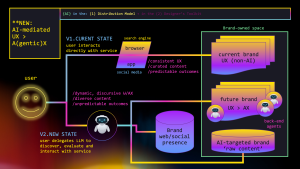
When products look identical on paper, the levers that remain are the lived quality of the service, the trust around it, and how a brand shows up for communities that care. The rational checks come first. If everything passes, the product’s aura, look, and feel make the choice stick.
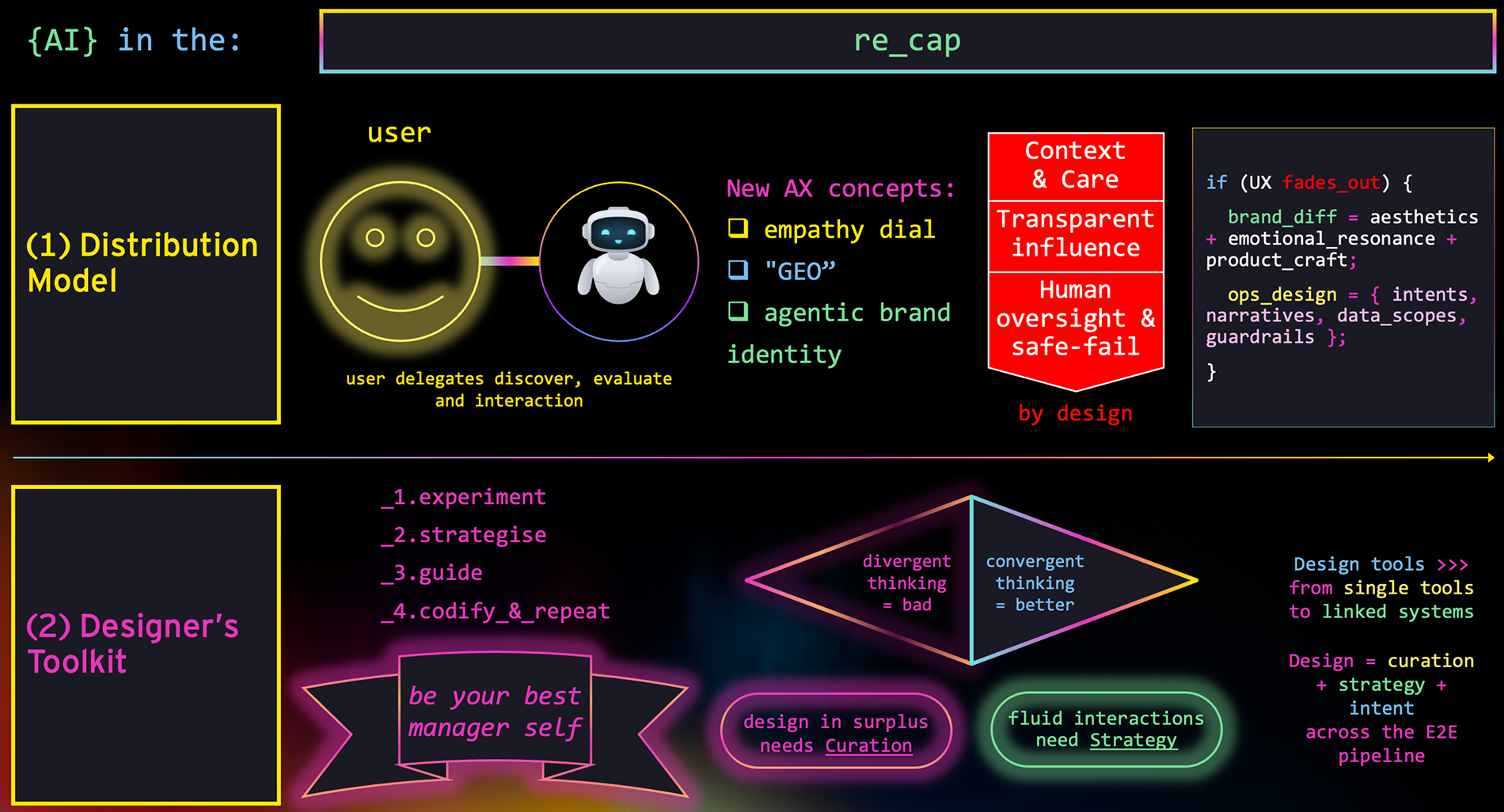
During the session, I used the term AX, agentic experience, as a label for this work: the layer of rules, examples, and constraints that shape how assistants act on behalf of a brand and a user.
In AX, design has to care about both territories at once: what you own and can still design end-to-end, and how you appear inside someone else’s assistant.
This is also where ethics must arrive early. The assistant sits in what feels like an intimate user space. People treat it like a trusted friend. Sponsorship has to be clearly marked. Suggestions should be checked against the goal the user set, not only what the brand wants to sell. There must be a quick path to an actual person when judgment is needed. Design carries this responsibility, not only policy.
So the work shifts. We now prepare materials that have to live well inside the space of personal assistants:
- Clear fact sheets that a model can parse and cite
- Tone rules, so brand voice does not drift
- Small, context-aware micro experiences that live inside someone else’s canvas yet still feel like your brand
- Visible consent and provenance patterns inside the flow
AX is the glue that holds this together.
What happens to UX when pages turn into conversations
The human needs do not change. People still want that spark in discovery, clarity in the middle comparison stage, and confidence and control at the moment of action.
What changes is the design artefact that carries those moments. Screens remain as our deliverables, but we will also ship:
- Interaction models
- Behavioral patterns for agents
- Short narratives that help comparisons land
- Small recipes that let a surface recompose itself for a situation
A few tools help structure this.
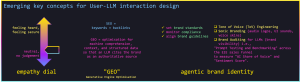
- The empathy dial sets the acceptable range of tone. Some contexts deserve neutrality; others benefit from warmth. A debt collection agent and a creative-writing companion should not sound the same.
- GEO, generative engine optimization, is less about keywords and more about structure and clarity, so a model can reliably cite you. In the LLM world, comprehensive, coherent documentation reads as authority.
- Brand work has to adapt and add new disciplines: tone-of-voice engineering, sonic cues where sound matters, and agentic brand audits to see how popular models currently describe you.
The goal is to be legible to people and to machines, in that order. If a human cannot fully understand and get your message, the model will only amplify the confusion.
Working at the speed of Change
Models improve in short cycles. Even when the headlines are quiet, capability moves every single week. To keep pace in all this change, I have noticed three steady principles.
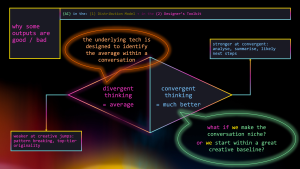
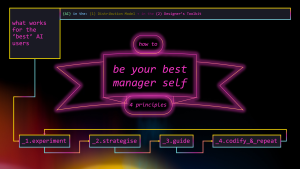
First, understand the tools. These systems are strongest at convergent thinking work. They analyze, summarize, cluster, and propose likely next steps. They are shakier at complex logical leaps and pattern breaks. Framing matters. I often use a bell-curve story: broad, generic questions invite answers from the middle of the curve, while narrow, expert questions pull from the right-hand tail. Start inside a strong, creative space, and the model will meet you there.
Second, practice four habits I see in high-performing colleagues.
- Experiment freely. Let the model read the mess rather than spending a week cleaning data it already understands. Test its limits. Ask what might seem like naive questions and think the unthinkable. Then push your model harder. It will surprise you.
- Set the strategy. Be disciplined. Name the outcome and the things you do not want, then break the job into human-sized steps. Follow the same design approach you would without an AI in the room.
- Guide the iterations. Use references and extremes, then triangulate towards the target.
- Codify and reuse. Once you are happy with an outcome, ask the model to restate the workflow as instructions for a team, then run that recipe again. Iterate and improve.
Third, accept that we now live with an “ask anything” button. Design becomes curation plus strategic intent. Without intent, you simply get noise, at scale. With intent, you get speed that lands. In surplus, the act of choosing is creative work.
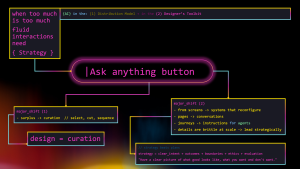
Write down what good looks like, what you refuse, and how you will tell the difference. Curate tightly and explain the choice. Fluid, non-linear interactions with LLMs need strategy more than precision.
From tools to systems: the new skill
We are also quietly moving from a world of discrete tools to one of connected systems. Tools such as Figma, Notion, and your design system library, multimedia GenAI platforms like florafauna.ai and weavy.ai (Figma acquired), and automation services like Make or Zapier, are no longer separate islands. Increasingly, the value comes from how they are linked.
That linkage is becoming a design skill in its own right. You could call it orchestration, stack literacy, or simply linking tools. I sometimes think of it as choreographing the stack. Whatever the name, it sits on two foundations:
- Knowing the models well enough to pick the right one for the job and understand what kind of input it needs.
- Having just enough data-architecture sense to see where information should live, how it should be structured, and how it flows between tools.
You do not have to become an engineer. You do need to be able to sketch the system: where intent enters, where examples live, how assistants fetch and apply them, and where feedback comes back in.
The good news is that this is something designers can learn by doing:
- Start small. Map one flow from brief to output.
- Connect two tools with an automation instead of doing a manual hand-off.
- Tag a handful of examples with the metadata you wish you had at scale, then let a model use them.
- Watch what breaks, adjust, and write down the pattern.
This loops back to the original principle for managing AI. If AI is scale, speed, and a second opinion, and design is empathy, intent, and curation. Then linking tools is how that empathy and intent become infrastructure, not just good intentions. The stack you shape is the channel through which the interface speaks back.
A closing note from the stage
None of this is settled. These pages are musings from practice, not doctrine.
If the interface is starting to speak back, our job is to give it better material and better manners. Treat AI as speed, scale and a second opinion. Spend the saved time on intent and on the parts that still deserve a human hand. Prepare materials that travel across both territories, because people will keep moving between them.
Then keep practicing, on real work, with real stakes. The loop is where the craft grows.
***
Author’s note: These are my own working notes and speculations. They grow out of Fine Art and Design education, an MA in Digital Direction at the Royal College of Art, and years across brand design, design systems, advertising and communications, and most recently service design. They do not represent my employer’s views.
Process note: This essay was drafted and structured by me, then edited and tightened in conversation with a large language model. The intent and responsibility for the words remain mine.
Vlad Molico is a Strategic Design and Innovation Lead at EY Studio+ in London, working on national-scale services where policy meets pixels.