
Last week in Berlin, we spoke with Will Shaw, Chief Design Officer at EY Studio+, to discuss something every designer needs, but few practice and feel: Commercial Confidence
With a background in service and experience design, Will leads multidisciplinary design teams to help large, complex, often regulated organisations to either optimize their service provision or rethink them entirely. Grounded in Human-Centered Design, he operates at the intersection of desirable, feasible, viable, allowable, and sustainable. Ensuring every decision works for users, business, and systems alike.
Fresh from his workshop from the ‘Masterclass: Designer, Claim Your Future Seat’ program, Will unpacks why understanding revenue, risk, and regulation isn’t a constraint on creativity. But it is what gives it power. In this interview, we discuss how designers can sharpen their strategic edge, align with decision-makers, and communicate in a way that makes great ideas stick.

How would you define commercial confidence for a designer?
Design is increasingly understood as being a valuable part of an organization. Design companies report greater market share, higher customer retention rates, and hold greater competitive advantage on average. But I think designers’ ability to engage in that conversation is still in development.

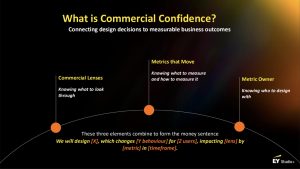
So, I think designers have done a really good job at creating impact, but they have not been good at taking ownership and responsibility for that impact. And so commercial confidence is about the ability for designers to understand the impact they have in an organization and how it’s measured and quantified.
I think that there are two known and understood key capabilities of a designer: The first is human centricity. The second is creativity. I think there are two more “lesser-known” capabilities of a designer: technology and commercial. Designers have done a good job over the last 10 years of increasing their technological fluency. However, it is now time to move towards commercial fluency. That said, it is not the responsibility of designers to do commercial measurements or give evidence of impact, but designers need to become commercially fluent. They need to be in that conversation; they need to be able to articulate the relationship between what they are producing and the commercial outcome for the entire organization.
Why do designers need commercial confidence?
I think designers need to have commercial confidence to have clarity in their role, but also in order to demonstrate their impact on the wider organization and demonstrate their worth and their value. Connecting their work to things their CEO cares about, rather than just aesthetics.
So, if you find yourself in a lift with the CEO and they ask, “What are you working on today?” You answer: “I’m redesigning some screens that are for a bank’s bereavement experience.” You should instead answer: “Through the redesign of a bank’s bereavement experience, we are helping customers through a difficult point in their lives. Guiding them through this time will enable the bank to retain assets under management in circumstances where people usually close accounts and leave the bank.”
So what do we have in the second answer? We have the human aspect, the commercial outcome, and the measurement that you are associating with your work. This equals an effective conversation that demonstrates the impact of design.

What three things could designers do today to improve their commercial confidence?
1) The first is to understand how the business makes and spends its money. So what is the revenue? What is the operational cost base? And how are they managed?
2) The second is to understand the organizational strategy, because it will always be a variation of maximizing revenue and profit, and controlling costs. So, where is the organization focusing?
3) Then the third thing is to have a clear point of view on how your own design activity relates to those organizational matters.
Commercial impact is not static, and the way to have commercial impact is to remain aware of and stay in alignment with the “ever-shifting priorities of the organization.
In Short, What We Learned from Will Shaw
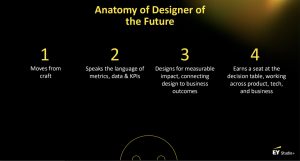
The recognition of design being a valuable organizational component is growing. And as designers, we need commercial confidence and take ownership of our impact by understanding how it is measured and quantified in business terms and concepts.
Designers must be able to articulate the value of their work by connecting and adapting it to the organization’s goals and what senior leadership cares about.