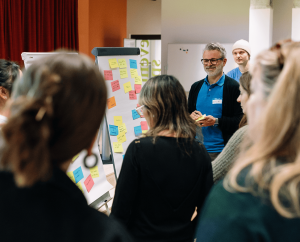

On a sunny afternoon in Berlin, inside Babbel’s headquarters—a language learning platform built around understanding each other—twenty-five designers sat down to confront something Europe rarely talks about openly: itself.
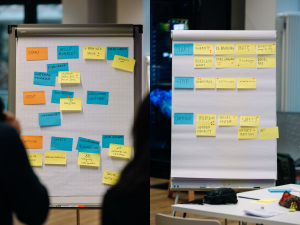
The premise was simple enough. A two-hour Designmatters Masterclass asking digital designers to consider what Europe should Keep, Stop, and Start if it wants a future worth inhabiting. It sounds abstract, even heavy. Yet within minutes the sticky notes filled up, the scepticism faded, and the conversations took on a surprising tone: practical, imaginative, and quietly emotional.
Something became clear very quickly. Europe is far better than it thinks it is. Designers can see that instantly. But Europe has a messaging problem so deep that even Europeans struggle to articulate its value. And in the absence of a compelling narrative, the whole project feels oddly fragile.
This article is an attempt to capture what surfaced in that Berlin room—and why designers, almost accidentally, might be the ones to help Europe recover its voice.

Europe’s awkward truth: enormous value, almost no pride
If there was one consensus in the room, it was this: Europe delivers extraordinary everyday value, yet struggles to make anyone feel genuinely proud of belonging to it.
Across the groups, participants listed the things they would keep: open borders, social safety nets, healthcare systems, cultural heritage, public spaces, walkable cities, scientific collaboration, and the simple freedom to live and work almost anywhere without bureaucracy swallowing you whole.
One participant told a story about visiting Bern and watching “the entire city float down the river after work.” An impromptu public waterpark, free, democratic, joyful. That image stuck with the room. It captured something that Europeans rarely celebrate: a collective infrastructure that quietly enhances daily life. And yet, as another participant put it, “We’re not proud enough. The US is too proud—but we’re not proud at all.” Europe’s problem is not performance. It’s perception. The value is there. The story is missing.

When designers look at Europe, they see a product with no onboarding
Designers are allergic to unclear value propositions. Give them any complex system—software, service, organisation—and they instinctively start mapping broken flows, missing screens, outdated logic, contradictory rules.
That instinct surfaced everywhere in Berlin. One designer said it plainly: “Europe has features people use every day, but no one has written the UX copy that explains why it exists.”
Another group compared Europe to a product designed by 27 product managers who never align their roadmaps. This wasn’t cynicism. It was clarity. When you treat Europe like a product—an imperfect but powerful one—you suddenly see the design potential hiding in plain sight:
• The friction of contradictory regulations
• The confusing messaging
• The invisible benefits
• The emotional distance between citizens and institutions,
• The opportunity for a shared narrative that feels lived rather than proclaimed.
Europe behaves like a system that was never given a narrative layer. And without narrative, people can’t feel a sense of belonging.
Why Europe struggles to tell its own story
The workshop transcripts revealed something else: Europe’s narrative problem is structural, not accidental.
Bureaucracy has become the default voice.
Designers from several countries described European communication as “PDFs, policies, and panic.” Humanity gets lost. Curiosity gets flattened.
Diversity makes storytelling difficult—but conformity makes it worse.
One group noted the EU’s strange tendency to regulate culture into sameness. “We’re designing consistency into places that should remain idiosyncratic,” someone said. Europe’s strength is precisely that Copenhagen doesn’t feel like Lisbon or Kraków.
The media’s obsession with America distorts Europe’s self-image.
Group after group complained that European news covers the US more than neighbouring countries. “I know what’s happening in California,” one designer said, “but not what Germany is voting on 300 km from my house.”
Outdated symbolism shrinks Europe’s identity.
A designer from Group 5 put it beautifully: “Our European brand is still Roman statues, old white men, and wine. That’s not Europe. That’s a museum gift shop.”
The room laughed, but it landed. Europe’s cultural self-portrait has frozen in time, missing its own diversity, modernity, and contradiction.
This is the narrative vacuum: Europe is rich in substance, poor in story.
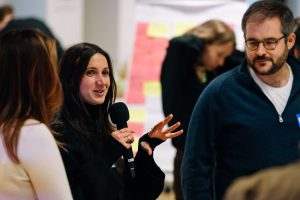
The designers’ diagnosis: what Europe should keep, stop, and start
Across five groups, patterns emerged with surprising clarity. These weren’t policy statements—they were the instincts of people used to shaping digital systems, services, and interfaces.
Keep: Europe’s everyday superpowers
Participants consistently placed their dots next to:
• Open borders
• Public spaces
• Cultural heritage
• Healthcare
• Education
• The ability to compromise (yes, really)
• Social systems that offer dignity
One voice: “We didn’t even write ‘democracy’ down because we take it for granted. That scared me.” Keeping what works felt almost like an emotional anchor—Europe’s rare combination of stability and humanity.
Stop: the self-inflicted design flaws
Here, the tone sharpened:
• Stop overregulating everything, including public space and culture.
• Stop contradictory laws that force local leaders to break one rule to follow another.
• Stop the “nation-first” mindset when negotiating globally.
• Stop overthinking to the point of paralysis.
• Stop exporting jobs and knowledge, then acting surprised by dependency.
• Stop the narrow cultural narrative that ignores Europe’s diversity.
• Stop bureaucratic gatekeeping that undermines inclusion.
One group phrased it like this: “Stop bureaucracy — start humanity.”
Start: the provocations that make Europe interesting again
This is where the designers’ imagination came alive:
• A European social year—an Erasmus for everyone, not just students.
• A European passport—symbolic, controversial, identity-shifting.
• A unified European voice in global negotiations.
• A massive European train network—fast, cheap, connective, climate-positive.
• Investing heavily in tech, science, and research—“now is the time,” one group said bluntly.
• Bolder experiments at the intersection of art, tech, and science.
• Dual-language infrastructure to make Europe more accessible to itself.
• A new story of European history—inclusive, diverse, honest.
• More failure culture—“be bold and embrace mistakes,” as one group urged.
• European-centric media so citizens know their neighbours as well as they know the US.
These weren’t utopian fantasies. They were prototypes. Designers don’t ideate for ideology—they ideate for feasibility.

So why did designers lean into Europe with such ease?
Something subtle happened in the room. People enjoyed designing Europe. That may sound small, but it’s significant. Europe rarely invites emotional connection. Or creative involvement. It sits at a distance—important, earnest, slightly dull.
But once reframed as a design challenge, something unlocked:
• Designers felt agency.
• They enjoyed working across cultures.
• The conversations became practical rather than abstract.
• Critique turned into constructive imagination.
• The energy shifted from “Europe has problems” to “Europe has potential.”
The real takeaway? Europe feels easier to improve than it feels to belong to. And that is exactly the narrative challenge.

Designers as narrative-builders for a continent
Designers are trained to work in ambiguity, shape meaning, build coherence, and make complexity legible.
The workshop revealed three roles they naturally slip into when discussing Europe:
1. Designers are narrative interventionists. They know how to uncover the emotional truth inside a system and express it clearly. Europe desperately needs that skill—less messaging, more meaning.
2. Designers are cultural translators. They bridge worlds, mindsets, and languages. Europe is a tangle of differences that needs precisely this connective tissue.
3. Designers are prototypers of possibility. They make the future graspable. Not theoretical. Tangible. Testable.
In Berlin, designers acted less like citizens and more like co-architects, not in a political sense, but in a cultural one. They didn’t debate Europe. They redesigned it.
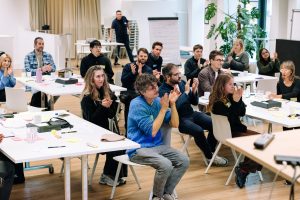
Europe isn’t a monument — it’s a prototype
The clearest conclusion from the Berlin Masterclass is this: Europe is not finished. It was never meant to be finished. It is a prototype in permanent beta—messy, frustrating, ingenious, and continually updated.
What it needs now is a story that reflects that reality: a story that is diverse, confident, future-facing, and emotionally resonant. Not propaganda. Not nostalgia. Something human, curious, and ambitious—something Europe has always been better at than it realises.
Designers cannot save Europe. But they can help Europe tell the truth about itself. And that might be the most powerful design intervention of all.
***
Would your company like to learn more about Redesign Europe or take part in a workshop?
Book Mads Quistgaard via LinkedIn or at mq@urgent.agency, and visit Urgent.Agency for more information.
About the Author
The Designmatters Masterclass in Berlin was the second workshop in a series of Redesign Europe sessions conceptualised and led by Mads Quistgaard. The first took place in the spring at Designmuseum Denmark in collaboration with the Danish Design Council. The ambition behind the series is straightforward: to help bring Europe forward through design.
Mads is the founder and Creative Director of Urgent.Agency and a former professor at the Royal Danish Academy.